Wendy's social media strategy is the definitive case study in real-time cultural agility: a fast-food chain that tore up the sanitised corporate playbook, empowered its social team to speak like actual humans, and grew net income by 49.7% in a single year. Here is what they did, why the psychology worked, and the lesson we draw from it in Chapter 9 of Marketing Wins.
The Problem with Traditional Social Media
For decades, corporate social media was handled by legal and PR teams, ensuring everything published was as sanitised, safe and rigidly promotional as possible. Brands operated as one-way broadcasting channels, pushing expected corporate messages into the void at audiences that were barely listening. This predictable approach created a significant psychological hurdle for marketers, explained by "schema congruity theory". Because modern consumers are constantly bombarded with commercial clutter, they have developed cognitive protective shields, or "advertising schemas", that help them instinctively identify and ignore traditional marketing.
When a brand posts a standard, safe PR message, it is "schema congruent": it matches exactly what the consumer expects, so it requires zero cognitive effort to process and is instantly forgotten. To break through the noise, brands must introduce "moderate incongruity", presenting unexpected but relevant information that surprises the audience, captures their attention and forces them to actively process the message. It is the same principle behind the absurdist creative we examine in our guide to the future of marketing connection.
What Wendy's Actually Did
Wendy's completely broke the corporate schema by throwing the traditional PR playbook out of the window. Instead of relying on polite, robotic customer service replies, they adopted a sharp-tongued, quick-witted online persona that sounded like an edgy internet comedian. Guided by social media managers like Matt Keck and Amy Brown, Wendy's began openly roasting their own followers and leaning heavily into real-time pop culture. They launched events like "National Roast Day", hopped on fast-moving internet memes and relentlessly mocked rival fast-food chains like McDonald's and Burger King.
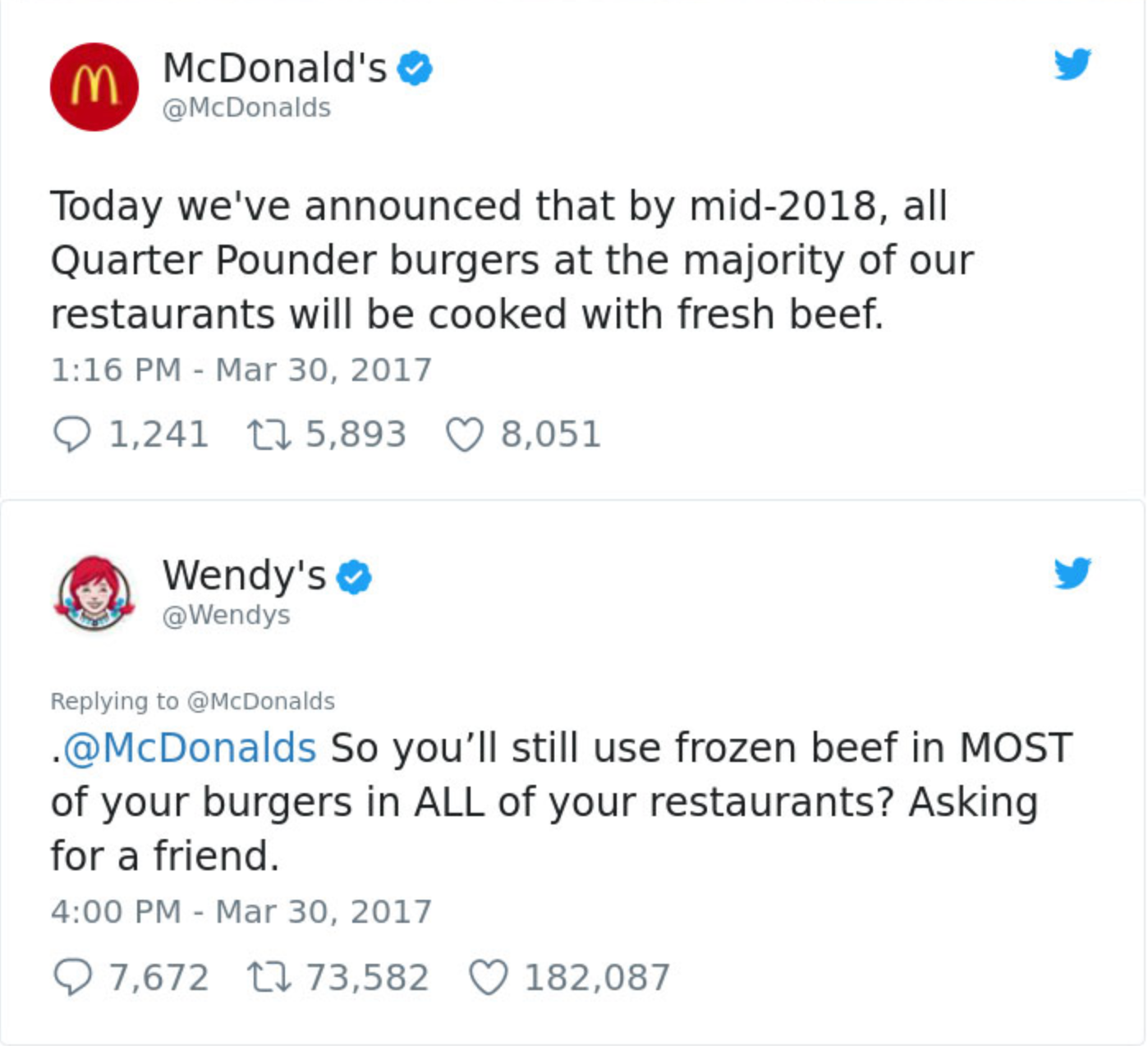
Most notably, they constantly hammered their competitors over their use of frozen beef, transforming mundane fast-food banter into viral entertainment. They even engaged a user in the legendary #NuggsForCarter challenge, daring him to reach 18 million retweets for a year of free chicken nuggets, an interaction that temporarily became the most retweeted post in Twitter history.
Why It Was Successful
The true skill behind Wendy's success was their mastery of real-time cultural agility and an authentic reactive voice. From a psychological standpoint, Wendy's used moderate schema incongruity perfectly: their savage tone was entirely unexpected from a corporate fast-food chain, but it remained deeply relevant because it was anchored to an actual product truth, their use of fresh, never-frozen beef. That undeniable factual difference meant their confident persona felt earned rather than performative.
This success also demanded immense corporate courage. Wendy's shortened their approval chain, bypassing the usual layers of corporate sign-off to empower their social team to respond to fans and rivals authentically and in real time. The agility proved incredibly lucrative. Wendy's follower count surged from 2.1 million to over 3.7 million, generating hundreds of millions of earned media impressions globally. Most importantly, the campaign moved the bottom line, helping Wendy's grow their net income by 49.7%, from $129.6 million to $194 million in a single year.

The Ultimate Marketing Win
Wendy's proved that in the digital age, a highly distinct, polarising and agile personality can generate far more brand loyalty and revenue than a multi-million dollar traditional ad campaign. They turned everyday Twitter interactions into a spectator sport, proving that audiences crave authentic human connection and entertainment over sanitised corporate speak.
Why does abandoning the safe PR playbook in favour of an agile, engaging voice pay off so handsomely? It comes back to a principle we set out in Chapter 9 of Marketing Wins:
Lazy, boring posts won't move any dial and can, in worst-case scenarios, ruin a business if the marketing isn't helping the sales... If your marketing is engaging, you're more likely to sell. It's the responsibility of your marketing team to ensure that the digital content that goes out is as engaging as it is informative
Wendy's is, in effect, that chapter made flesh. In Chapter 9, Managing an Integrated Strategy, we argue that engaging content comes from the people behind it: build a marketing team that mixes creatives, organisers, communicators and brave go-getters, then give them the authority to act. Wendy's shortened approval chain is exactly that principle in practice, and a 49.7% rise in net income is what it looks like when a business trusts its team to be relentlessly engaging.
The lesson holds at the gentler end of the spectrum too: when Nescafé Brazil hired 20 people just to chat, it rediscovered the same truth, that social media is a conversation, not a billboard. Distinct, agile and human beats safe, slow and corporate every time.
The book behind this article
Marketing Wins
Timeless integrated-marketing fundamentals from Elliott King and Aleksandra King: nine chapters bridging traditional strategy and digital execution, grounded in honesty, because people buy from people.